The heartbeat of India has always lain, deep and steady in its sumptuous cultural moorings. Held firm and strong down the centuries its incredible artisanal heritage is now sadly buffeted by the strong winds of change and decay in the 21st century. Economic duress is driving craftsmen to steer away from the laborious and time-consuming crafting traditions that have been their generational pride. Today people want done things quickly. The age of ready gratification has, over the years, resulted in the loss of many of our beautiful crafts. Steady patronage was the lifeblood of these crafts—be it from the royals, the nobility or the temples. This impatience to get things quickly has not served our artisans well. It is imperative that the few crafts, done the old way…not some machine-made replica, must continue to get our support.
Thewa Jewellery from Rajasthan
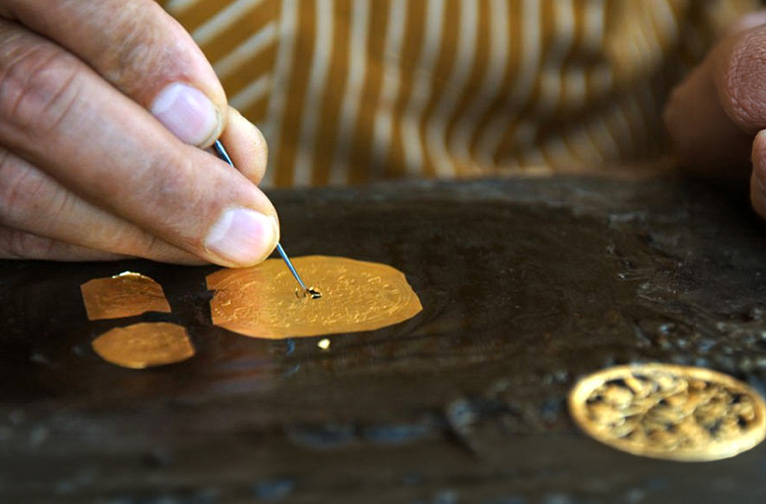
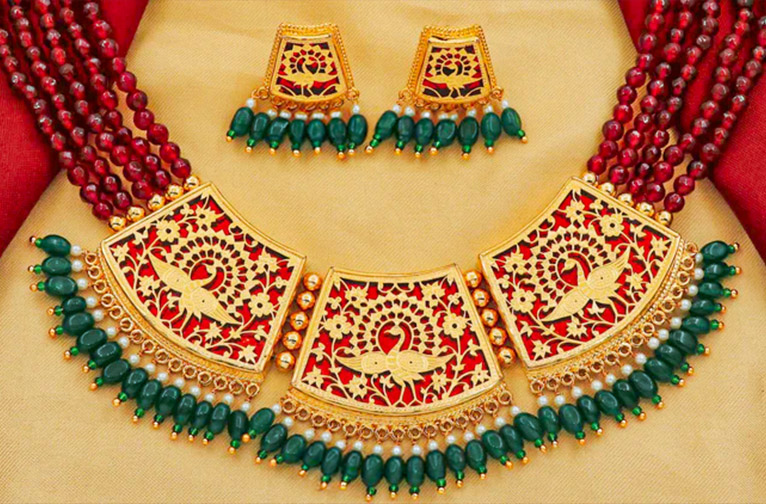
The royalty and nobility of Rajasthan have long been patrons of the arts and crafts. One of the primary examples of tradition is Maharajah Swai Jai Singh II, who, when he was building his new capital of Jaipur, provided a special place in the scheme of things for both commerce and creativity for artisans of every hue. Little wonder that today Jaipur, a fabulous treasure trove textiles, jewellery, marble and stone carving, paintings, from around the state, is now a part of the UNESCO Creative Cities Network (UCCN) and a designated ‘City of Crafts and Folk Arts’. When shopping for jewellery, it would be fantastic if you would lend your patronage to one of Rajasthan, most unique and incredible jewellery traditions, which is on the brink of vanishing. This is Thewa Jewellery, which, with the help of a few dedicated cultural aficionados is quietly inching its way back from near oblivion. A name that is synonymous with this is revivalist couture jeweller Roopa Vohra, who started this journey in the 1990s.
The specialisation of a small community in Pratapgarh in Rajasthan was elevating the beauty of handmade coloured glass. Thewa means to set. By capturing molten glass in very fine engraved filigree sheets of no less or more of 23 carat gold foil, the artisans created the most embellishments for artefacts. Later it evolved into the most exquisite jewellery pieces, highly prized by the royals in its heyday. The entire complexity of the process, including the hand making of the glass, beating the gold into thin foils and then fusing the glass and the gold is incredibly intricate and nerve wracking. The delicacy of the handcrafted workmanship was never easy for these artisans, but the pride they took in their craft, a seamless fusion of Indian and Mughal art forms, was measureless as they fiercely protected this ancestral legacy.
The fine art of Thewa traces its beginnings to Nathu Lal Sonewala, who legend has it was commissioned by Rao Maan Singh of Pratapgarh to produce something extraordinary for his court. This was in1707. Another early patron was Kishangarh’s Maharaja Samant Singh, in 1767. Common motifs in the design included floral patterns, wildlife such as peacocks and elephants, geometric patterns, Hindu mythological figures and scenes from royal life.
Therukoothu Mask Painting from Tamil Nadu
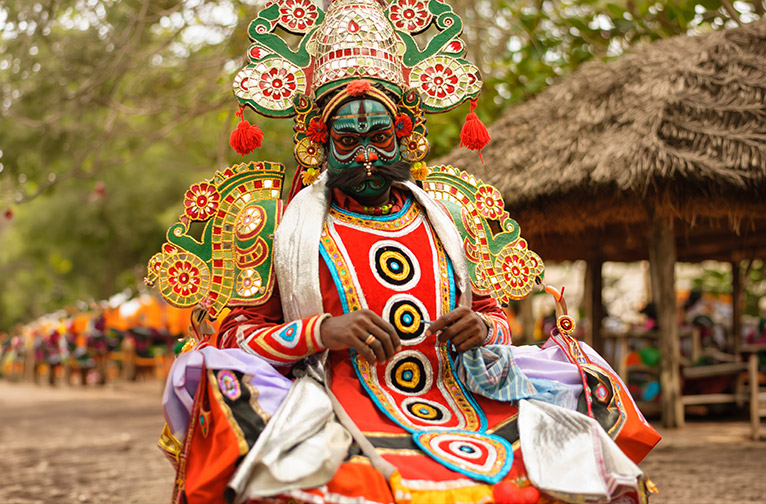
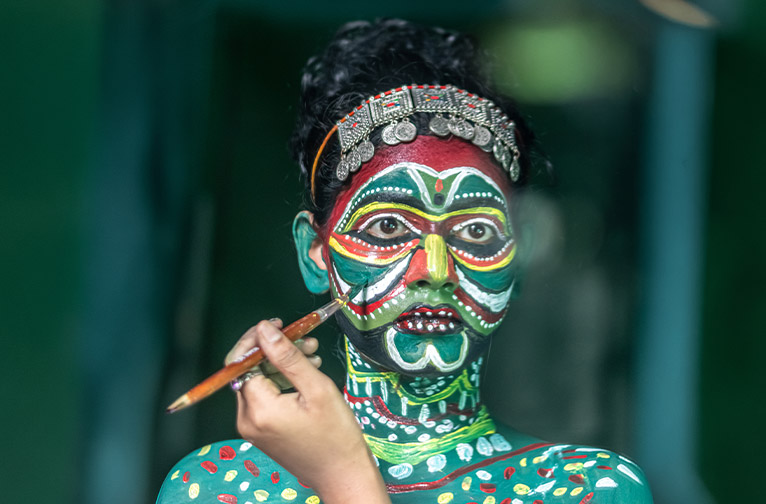
We are pretty familiar with the stunning masks created in Kerala for the Kathakali dance-drama of Kathakali. But how many of us remember the Therukhoothu mask painting of Tamil Nadu? Primarily a unique tradition in street theatre Therukhoothu features elaborate painterly facial makeup and masks, with which the folk theatre performers seek to ignite the energy between the performance and the audience. The tradition, oral, visual, and spiritual, is intrinsically linked to the ritualistic sacred mask making and face painting. Every colour in the is steeped in significance, each character, drawn largely from Hindu mythology is defined by the design hand painted on the mask. At least 15 distinct colour layers are applied in the face makeup; it can take 2–3 hours before each performance. The entire effect is further underpinned by the costumes, colours and motifs which distinguish the forces of good and evil; they signify the persona of the character complete with flaws and virtues.
The tradition of Therukoothu finds mention in Sangam literature (2nd century BCE to 3rd century CE) and is treasured as one of India's oldest performing art forms. Traditionally the performance would run for about 8 to 12 hours between sunset to sunrise — a truly physically taxing, but exhilarating experience for both performers and audience. Training begins from childhood for the performers, who hone their skills in the art right into adulthood. Traditionally, performed by men it traces its origins to the Tamil Nadu districts of Salem, Namakkal, Dharmapuri and Erode. You can catch performances in the northern districts Kanchipuram, Villupuram, Thiruvallur, and parts of Chengalpattu. It’s also linked to the Draupadi Amman festival — annually held in temples raised to Draupadi. A good time to enjoy a performance is in Aadi (July–August) and Panguni (March–April). Traditionally it is performed in temple courtyards, open grounds and street corners.
Phulkari from Punjab
Grannies and mums have long been known to drive this household tradition in rural Punjab. Early references to the craft can be traced back to the 15th century. It finds mention in Punjabi literature in the 18th century, the most colourful reference being the life and times of the immortal lovers Heer-Ranjha from folklore.
This almost ritualistic embroidery tradition would mark the significant milestone events of a girl’s rites of passage, starting from the auspicious time of her birth to be gifted to her on her wedding day. These beautiful dupattas or light stole-like scarves were hand embroidered by the ladies as heirloom pieces passed on from generation to generation and preserved with infinite care. Rendered on coarse hand spun undyed, off-white or red cotton, known as khaddar, phulkari was deeply embedded in the social fabric of undivided Punjab.
Phulkari or "flower work," involves embroidery rendered with vibrant untwisted silk floss (called patt) over the coarse cotton. The simple darning stitches made from the reverse side of the fabric resulted in stunning designs on the right side up of the fabric.
Phulkari embroidery comes in many forms. It can be as light as Chope, which features embroidery in a single colour, either golden or yellowish gold along the borders and is a gift from her grandmother to a bride during the wedding ceremony. Or it can be the richer version Bagh Phulkari which is like a full-blown garden of flowers covering every inch of the cloth. The embroidery is so vibrant and dense, it gives the impression that the embroidery is the fabric itself. In Phulkari dupattas, on the other hand the embroidery is more spaced out and you can actually see the colour of the base cloth underneath. The Vari-Da-Bagh Pulkari is gifted to the bride by her in-laws on her arrival in her new home. The embroidery is depicted on orange-reddish khadi fabric.
Thirma Phulkari rendred on white khaddar with embroideries in bright pink to deep red tones was favoured by the elderly Punjabi women as well as widows. Sainchi Phulkari pieces reflected life in the villages. Common motifs included goats, cows, elephants, big cats, scorpions, peacocks sprinkled amidst figures of wrestlers, farmers, weavers, etc. Kaudi (shells) Phulkari was often worn by women as a fertility rite to increase their chance of having a baby.
Phulkari is witnessing a quiet revival in its original handcrafted form, as against the speedier, less organic machine-made replicas in the market. Phulkari was never about commerce— from the very start it was purely a household legacy. In modern times the beautiful embroidery is finding voice on salwar suits, jackets, bags, cushion covers etc in various fabrics. Phulkari received Indian Geographical Indication recognition in 2010/11.
Ganjifa Cards
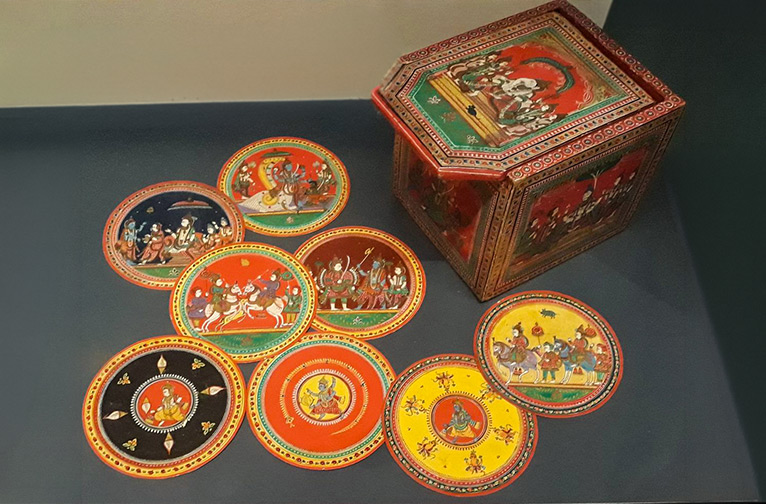
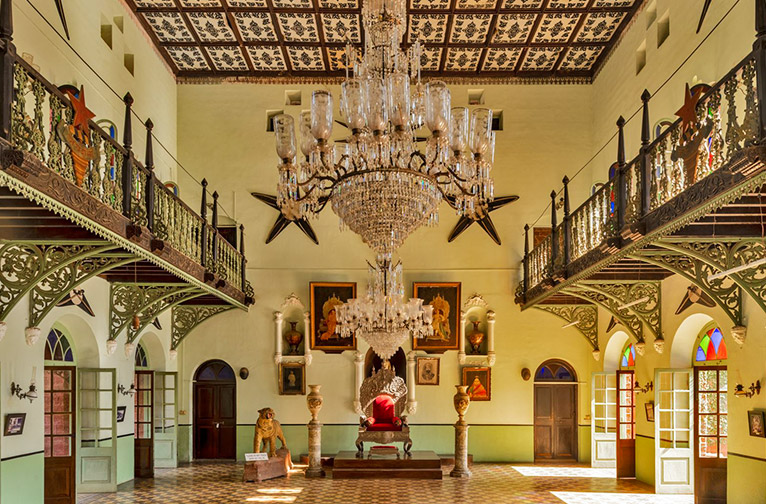
This Diwali, how about giving card playing buffs a pack of beautifully illustrated circular playing cards— Ganjifa cards? The tradition is well documented in Odisha, Andhra Pradesh, Rajasthan, Maharashtra’s Konkan region and Karnataka’s Mysore region. The circular playing cards were a Persian import, introduced in the times of Mughal emperor Akbar in the 16th century. A pack of Mughal ganjifa comprised 96 cards in eight suits of twelve cards each. The hand painted circular card game became a big pastime in courtly traditions across the Indian subcontinent thereafter. The Hinduised version of the suits picked up stories from Hindu mythology, often depicting the Dashavatara (Lord Vishnu’s 10 avatars). Themes could vary, incorporating courtly life, signs of the zodiac etc. Bird and animal ganjifas were popular in Rajasthan. In Odisha the Mughal eight-suited ganjifa is called ath rangi sara. But it replaced the figures on the court cards with those of Hindu divinities and heroes.
In early times ganjifa cards were available in ivory, tortoiseshell, and sandalwood, and even ornamented with silver or gold foil, and precious stones. The ganjifa cards produced in the court tradition of the Wodeyar rulers were markedly different to the style favoured on Maharashtra's Konkan coast. Inevitably, over time the tradition transformed into another style, and by the 20th century had bowed down to mass production, leaving little room for the original painstaking hand crafted form to survive. With royal patronage diminishing, and mass production holding court, artisans of the old school quit, finding other avenues to augment family incomes.
The Sawant Bhonsles of Swantwadi in Maharashtra's Sindhudurg district have gone a step further in protecting the tradition by also converting a wing of Sawantwadi Palace into a Ganjifa-themed boutique hotel. Look carefully at the doorknobs, mirrors and furnishings and you’ll find each of them are hand-painted in the ganjifa tradition. Even the suites in the hotel are named after an avatar of Vishnu. If you are interested check out India Post’s, first-ever circular postcards, designed with Sawantwadi's artisans and inspired directly by Ganjifa's Dashavatara motifs.
Kalighat Painting from Kolkata
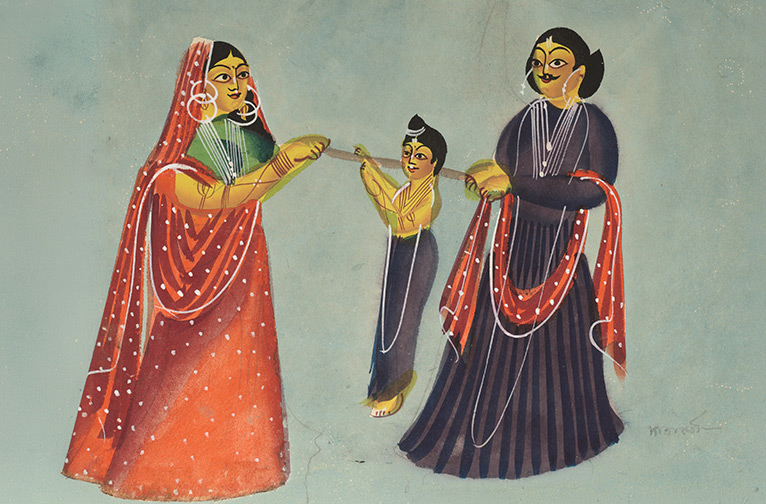
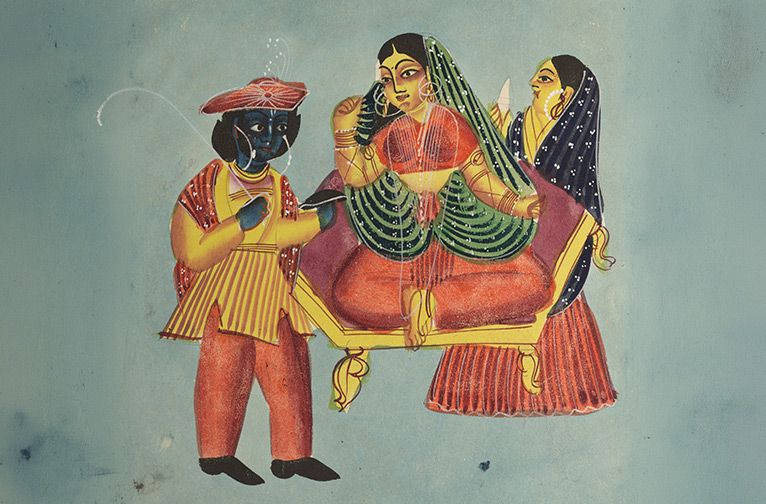
Legendary Bengali artist Jamini Roy is inextricably associated with Patua Art, also popular as Kalighat painting, the Bengal folk school that grew around the Kalighat Kali temple — quick, cheap watercolours rendered on a single sheet of mill-made paper, sold from stalls by the temple gate to visiting pilgrims as a souvenir. A pat was a painted scroll; a patua (the community, also known as Chitrakar or, “picture-maker”). It was initially developed by specialized scroll painters called patuas. Though Roy was deeply immersed in the western techniques of his craft, he found a new inspiration for his art in works of Bengal’s folk painters. Next time you are visiting a gallery showcasing his works, look for the inspirational patua traditions that mark his ouvre—the flat perspective, simplified forms, quick brushstrokes, and bold outlines. Caluatta (Kolkata) in the 19th century was a thriving hub of creative explosions in the art forms on a large scale. What caught the imagination of culture buffs about Kalighat watercolours was that they were quick, bold, and sharp in observation—and inexpensive. No theme was too small for their attention: the quirky side of the contrary lifestyle of the city, nor the gossipy vibrancy of its social whirl or the gods and goddesses. The form is slowly being pulled back from the brink of extinction.
Aranmula Kannadi from Kerala
This exquisite tradition emerged from secretive methods of polishing metals alloyed with silver, bronze, copper and tin, to a mirror-like shine, from the tiny village of Aranmula from Kerala’s Pathanamthitta. Legend has it that the tradition can be traced back to Vedic times. These stunning mirrors go by the name of Aranmula Kannadi. To this day its crafting tradition is a fiercely held generational secret. Picking one of these mirrors should definitely be on your bucket list when visiting Kerala. Not only are they polished to an exquisite sheen, but they are also adorned with gorgeous carvings.