As the festival of Diwali approaches our thoughts turn to Lord Rama’s triumphant return from exile and how dread and darkness are chased away by the illumination of hope amongst his jubilant people. Each year, Ayodhya, his birthplace and family home, becomes the scene of hectic activity as diyas, floral ornamentations and sacred offerings are presented by millions of devotees at the stunning Ramjanam Bhoomi complex.
As Ayodhya, once the capital of Raja Dasharath’s kingdom of Kosala, lay steeped in silences by the waters of the Saryu River, awaiting the return of its beloved son with his wife Sita and brother Lakshmana, it never forgot the sad events that led to leaving home and wandering the land for 14 long years. How can it not mark that legendary reunion with his people, after victory over the demon king Ravana of Lanka. Ayodhya also knows how to celebrate, and it did that with a grand display of illuminations from over 22.23 lakh diyas placed across 51 ghats on the eve of Diwali, also known as Chhoti Diwali or Kartik Krishna Chaturdashi. This year Deepotsav, can surely be no less, and it would serve you well the join the mighty throngs to witness this amazing religious spectacle.
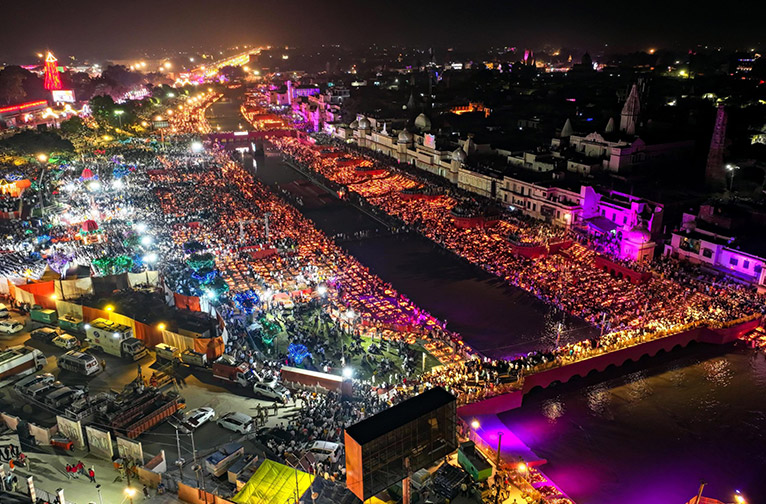
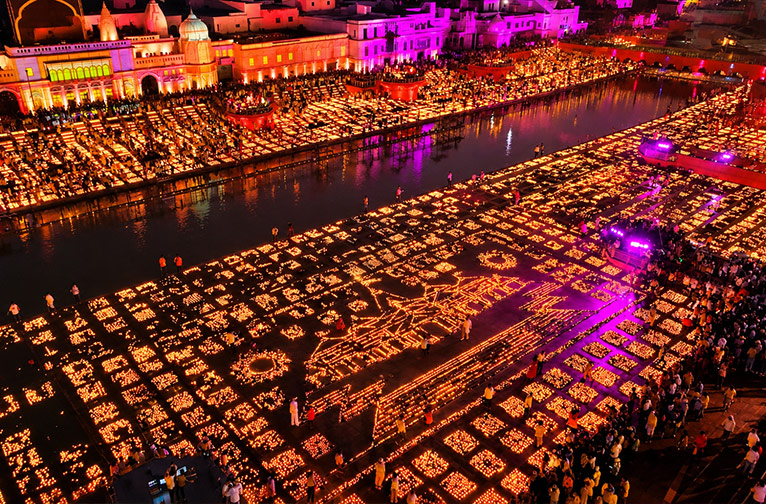
If Varanasi was always your go-to destination for Diwali, Ayodhya beckons you this year to sample its alluring attractions…not the least being the lavishly decorated Ram Mandir. Were you aware that Ayodhya established a new Guinness world record of over 22.23 lakh lighted lamps as compared to the 6,06,569 lamps that were lit on November 14, 2020, at the Ram Ki Paidi during the Ayodhya Deepotsav? It also captured another record when in 2025 Ayodhya held the Largest Group Aarti, with over 2,128 priests performing a synchronized aarti, while simultaneously rotating those massive lamps along the banks of the Saryu River.
With the consecration of Ram Janmabhoomi Mandir on 22 January 2024, it was no surprise that devotees started arriving in the riverside township in huge throngs, breaking the silences and sadness of yesteryears.
Deepotsav Ayodhya 2026 is slated to be celebrated at Ram Ki Paidi. This 10th edition of the festival will be held from November 7-9, 2026. On the first day, which is November 7, the crowds will be treated to a colourful Shobha Yatra marking the lavishly appointed Ramayana tableau procession. You will get to see the primary characters of this epic event– Lord Rama, Sita, Lakshmana, Hanuman, Ravana, hit the gaily decorated streets as they wend their way from Saket College to the grounds of Ram Katha Park.
Do try and make it for this main event, where you will witness the glittering spectacle of over 28 lakh earthen diyas which will illuminate Ram Ki Paidi, the central ghat on the Saryu River. Equally unmissable will be the lavish Saryu Maha Aarti to be held between 5:30-6:30 pm, prior to the mass lighting of the diyas which extends to adjoining Naya Ghat and a great length of the riverfront. This will be followed by Laser Show and 3D hologram projections; close on its heels will be a stunning 500-drone aerial show. One can enjoy a lively musical programme at the end of the night’s celebrations.
An explosion of illuminations will put the spotlight on the Ram Janmabhoomi Mandir on the day of Diwali, which is November 8, 2026. Additionally, Ayodhya comes alive with fireworks and well attended Diwali aartis held at iconic spots like Kanak Bhawan and Hanuman Garhi.
On November 9 Ayodhya will saturate itself in the rites and rituals of Govardhan Puja and Annakut. The 56 Bhog Prasad distribution will be held at all the major shrines in the city and Gau Puja will be conducted at Karsevakpuram.
Ayodhya has long been renowned as a centre of learning and spiritual discourse. In the 18th century it had a pivotal role under the rule of the Awadhi Nawabs but with the shifting of their capital to Lucknow lost its significance considerably. It was the call for the construction of the Ram Mandir which lifted it from its doldrums, heralding its revival as a religious centre for Hindu India once again. Ayodhya is one of the seven Mokshdayini Saptpuris, or the seven noble tirthas (or pilgrimage points), for those of the Hindu faith; it also holds special significance for Jain and Buddhist devotees.
For the unaware, the Saryu River also holds considerable significance as a venerated waterway. It is one of the divine Sapt Gangas, or Seven Gangas. Lord Rama’s brother Lakshmana ended his life in the river by committing jal-samadhi and transcended into his avatar as Sheshnaga. No longer able to bear the loss of Lakshmana and Sita, his companions in exile, Lord Ram also committed jal-samadhi at what is now the hallowed site of Guptar Ghat; following his death he transcended into his avatar as Mahavishnu.
Ayodhya is steeped in myths and legends and many of its iconic sites reveal these cherished tales. An all-year-round destination Ayodhya offers many aspects of its history, heritage and spiritual diversions to explore.